
iGaming is defined as any form of wagering involving real money conducted exclusively through digital platforms such as smartphones and computers. It is distinct from land-based gambling and from casual gaming that carries no financial stakes. The global online gambling market was valued at $78.66 billion in 2024 and is projected to reach $153.57 billion by 2030, growing at a compound annual growth rate of 11.9%. That scale makes iGaming one of the fastest-growing sectors in digital commerce. Regulatory bodies, payment processors, game certification agencies, and platform providers all form part of the infrastructure that keeps this industry running.
What is iGaming and what activities does it include?
iGaming covers every form of real-money wagering delivered over the internet. The defining characteristic is financial risk. Without real money on the line, an activity is casual gaming, not iGaming. This distinction matters legally, technically, and commercially.
The most common iGaming verticals are:
- Online casinos: Slots, blackjack, roulette, baccarat, and live dealer games streamed in real time from studios
- Sports betting: Fixed-odds wagering on football, basketball, tennis, and other sports events
- Poker: Real-money card games played against other players in online rooms
- Esports betting: Wagering on competitive video game tournaments, a fast-growing vertical
- Online lotteries: Digitized number-draw games operated under national or regional licenses
- Bingo: Real-money bingo rooms hosted on dedicated platforms
Each vertical operates under its own technical requirements and licensing rules. A sports betting platform needs real-time odds feeds and risk management tools. A live casino requires low-latency video streaming and studio infrastructure. An online poker room depends on certified random number generators and anti-collusion systems. The diversity of formats is one reason the iGaming industry has grown well beyond a single product category.
Casual social games that award virtual coins or prizes with no cash value fall outside iGaming's scope. Regulation does not apply to them in the same way. The moment real money enters the equation, the full weight of compliance, licensing, and consumer protection requirements applies.
How does the iGaming industry function as a broader ecosystem?
iGaming is not just a gambling product. It is a tech-driven ecosystem that includes technology providers, payment processors, regulatory compliance firms, affiliate marketing networks, and cybersecurity specialists. Most of these players never interact with end-users or handle a single bet directly.

The "i" in iGaming stands for both "internet" and "interactive," reflecting the industry's shift from simple digital replicas of physical games to complex, real-time integrated platforms. That shift required an entirely new layer of supporting businesses.
The key roles in the iGaming B2B ecosystem include:
- Platform providers: Supply the core software that operators use to run their sites, including player account management, game aggregation, and reporting tools
- Game providers: Develop and license slot games, table games, and live dealer content to operators
- Payment providers: Integrate deposit and withdrawal methods, including cards, e-wallets, and cryptocurrency, while managing processor restrictions
- Compliance and legal firms: Handle licensing applications, anti-money laundering programs, and ongoing regulatory reporting
- Game certification labs: Test random number generators and game math to verify fairness before a title goes live
- Affiliate marketing platforms: Track player acquisition through publisher networks and manage commission structures
- Cybersecurity providers: Protect platforms from fraud, bot attacks, and data breaches
Specialized companies in game certification, affiliate marketing software, and cybersecurity contribute to the ecosystem without directly handling players or bets. Their work is invisible to the average player but critical to industry integrity.
Pro Tip: If you are entering iGaming as a business, map your supply chain before you launch. Operators who skip due diligence on platform providers or payment processors often discover the gaps only after going live, when the cost of fixing them is highest.
What are the regulatory and compliance requirements governing iGaming?
Regulation is the single biggest operational variable in iGaming. Every market sets its own rules, and those rules determine which products you can offer, to whom, and under what conditions.
Regulatory standards require operators to verify player age before granting access. The minimum age is 18 in Europe, the UK, and Malta. In most U.S. states, the threshold is 21. These are not optional guidelines. Failure to enforce age verification is a licensing violation that can result in fines or license revocation.
Beyond age checks, operators must implement:
- Self-exclusion tools: Players must be able to block themselves from the platform for defined periods
- Deposit limits: Operators must allow players to cap their daily, weekly, or monthly deposits
- Reality checks: Timed notifications that remind players how long they have been active in a session
- Anti-money laundering (AML) programs: Ongoing monitoring of transactions for suspicious patterns
- Know Your Customer (KYC) verification: Identity checks that confirm player identity before large withdrawals
Jurisdictional differences create real complexity. An operator licensed in Malta under the Malta Gaming Authority faces different reporting obligations than one licensed in New Jersey under the Division of Gaming Enforcement. Operating across multiple markets means maintaining parallel compliance programs. Legal and compliance services have become a dedicated industry segment precisely because this burden is too large for most operators to manage alone.
What drives the rapid growth and market trends in iGaming?
The iGaming market's growth is not accidental. Several structural forces are accelerating it simultaneously.
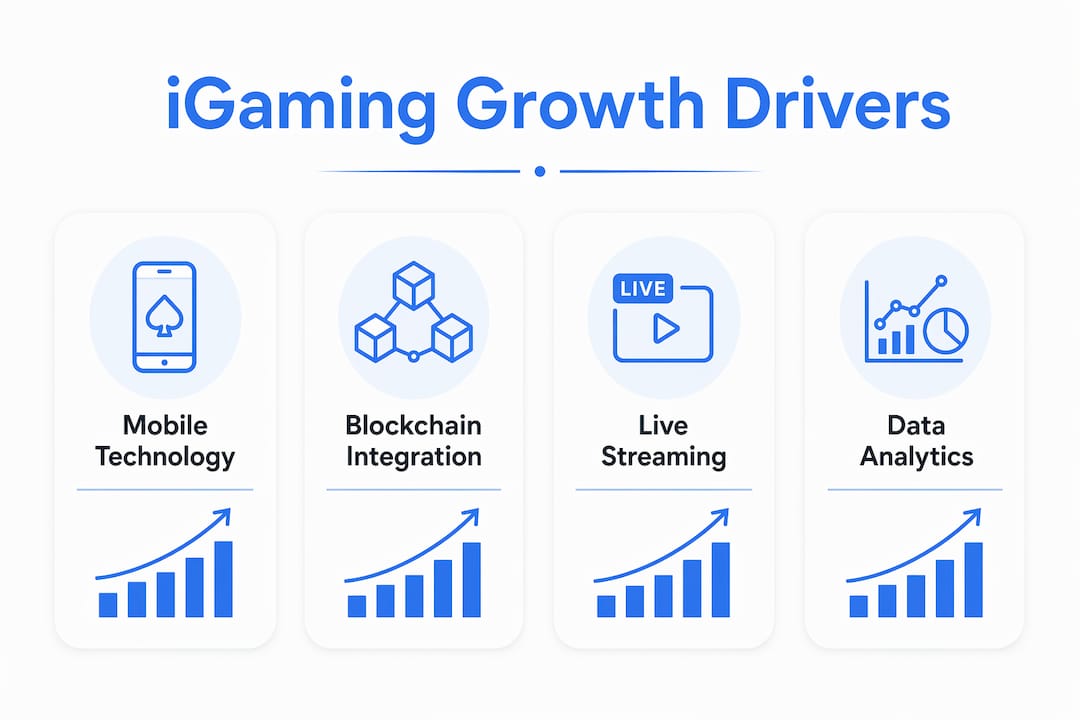
Mobile technology, blockchain integration, live streaming, and real-time data analytics are the primary drivers of iGaming's expansion. Mobile devices put a full casino or sportsbook in every pocket. Live streaming technology made live dealer games viable at scale. Blockchain introduced provably fair gaming and cryptocurrency deposits, opening new player segments.
| Growth driver | Impact on iGaming |
|---|---|
| Mobile technology | Expanded addressable market to smartphone users globally |
| Live streaming | Enabled real-time dealer games with broadcast-quality video |
| Blockchain and crypto | Added payment flexibility and provably fair game verification |
| Real-time data analytics | Improved personalization, risk management, and player retention |
| Regulatory expansion | New U.S. state markets and emerging markets in Latin America and Africa |
The COVID-19 pandemic accelerated adoption significantly. Land-based casinos closed globally, and many players who had never wagered online made their first deposits during that period. A substantial portion of those players remained online after restrictions lifted.
"Success in iGaming depends more on technical infrastructure and regulatory management than on game content. Operators who treat technology as a secondary concern consistently underperform those who treat it as the core product."
Cryptocurrency acceptance is now a standard expectation in many markets, not a differentiator. Esports betting is growing as a standalone vertical, with dedicated platforms and odds compilers focused exclusively on titles like League of Legends, CS2, and Dota 2. Regulatory fragmentation remains the primary challenge. An operator expanding from one regulated market to three must often rebuild compliance programs from scratch for each jurisdiction.
How do technology and payment systems affect iGaming operations?
Technology is not a background function in iGaming. It is the product. Platform uptime, latency, and processing speed directly determine whether players stay or leave.
Live dealer games are the most technically demanding iGaming product. A dropped video frame or a two-second delay in a blackjack hand destroys the experience. Operators running live casino products need dedicated server infrastructure, content delivery networks, and real-time monitoring. AI and cloud services have become central to managing this load, allowing platforms to scale during peak traffic without manual intervention.
Payment processing is the second major operational challenge. Many traditional card processors decline iGaming transactions due to chargeback risk and regulatory exposure. Operators must build relationships with specialized payment providers who understand the sector and can offer alternative methods including e-wallets, bank transfers, and cryptocurrency gateways. A platform that cannot process deposits reliably loses players at the first friction point.
Operators often fail due to fragmented international regulations, payment processor issues, and technical infrastructure challenges like maintaining uptime for live games. These are not edge cases. They are the most common reasons early-stage operators exit the market within their first two years.
Pro Tip: Before selecting a platform provider, request documented uptime statistics and ask specifically how they handle payment processor failures. Vague answers are a red flag.
Game certification is another non-negotiable. Before any game goes live in a regulated market, an independent testing lab must verify that its random number generator meets the required statistical standards. Skipping this step is not possible in licensed jurisdictions. Game certification is a fixed cost of doing business, not an optional quality check.
Key Takeaways
iGaming is defined by real-money wagering over digital platforms, and success in the sector depends on mastering technology, compliance, and payment infrastructure equally.
| Point | Details |
|---|---|
| Core definition | iGaming is real-money wagering conducted exclusively through digital platforms, not land-based venues. |
| Market scale | The global market was valued at $78.66 billion in 2024 and is projected to reach $153.57 billion by 2030. |
| Ecosystem breadth | The industry includes platform providers, game developers, payment processors, compliance firms, and certification labs. |
| Regulatory requirements | Age verification, self-exclusion tools, AML programs, and KYC checks are mandatory in all licensed markets. |
| Technology is the product | Platform uptime, payment processing reliability, and game certification determine operator success more than game content does. |
iGaming is more complex than it looks from the outside
I have spent years watching businesses enter iGaming with a clear picture of the consumer product and almost no picture of the infrastructure beneath it. They see the slots, the sportsbook, the live tables. They do not see the certification lab that cleared each game, the compliance officer managing three separate licensing regimes, or the payment aggregator quietly routing deposits around processor restrictions.
The industry's real complexity lives in that invisible layer. The "i" in iGaming does not just mean internet. It means interactive systems, integrated compliance, and interconnected technology stacks that have to work simultaneously. When one piece fails, the whole product fails with it.
My honest view is that most newcomers underestimate regulatory fragmentation more than any other factor. A business that operates cleanly in Malta can spend 18 months and significant capital just to meet the requirements of a single U.S. state. That is not a barrier to entry. It is a barrier to scale.
The operators who build durable businesses in this sector treat compliance and technology as core competencies, not vendor problems to outsource and forget. They hire compliance officers before they hire marketing directors. They test their payment stack before they launch their first campaign. That discipline is what separates the operators still running five years in from those who exit after two.
For anyone entering iGaming now, the market opportunity is real. The $153.57 billion projection by 2030 is not a ceiling. But the path to capturing any of it runs directly through the ecosystem, not around it.
— Mihail
How Igamingecosystem maps the iGaming industry for operators and partners
The iGaming industry is large, and finding the right service providers within it takes time that most operators and developers do not have.
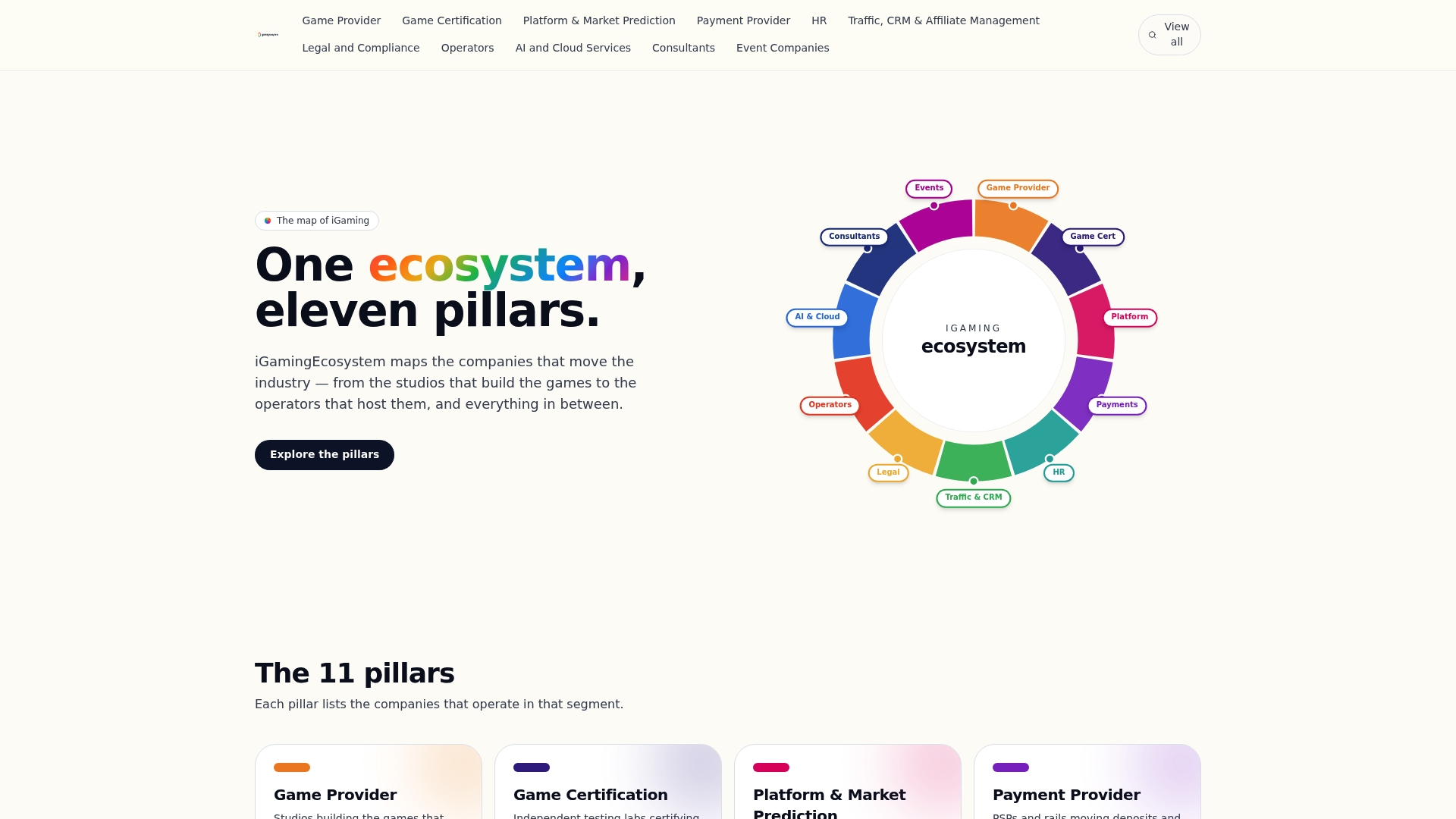
Igamingecosystem maps the companies that power the industry across eleven service categories, from game providers and payment processors to legal and compliance specialists. Rather than listing every company in a category, Igamingecosystem connects stakeholders to providers that match their specific operational needs. Operators facing licensing challenges, developers seeking platform partners, and affiliates building traffic programs all use the directory to reduce search time and improve vendor selection. The platform and market prediction category is particularly useful for operators evaluating software infrastructure before committing to a build.
FAQ
What does iGaming mean?
iGaming refers to any real-money wagering activity conducted over digital platforms such as computers and smartphones. The "i" stands for both "internet" and "interactive," reflecting the technology-driven nature of the industry.
How is iGaming different from regular gambling?
iGaming is gambling delivered exclusively through digital channels, without physical presence at a casino or betting shop. Land-based gambling requires a physical venue; iGaming requires only a licensed platform and an internet connection.
What types of games are included in iGaming?
iGaming includes online casino games, sports betting, poker, esports betting, online lotteries, and bingo. All involve real-money wagering and operate under licensing and compliance requirements.
Is iGaming legal?
iGaming legality depends on the jurisdiction. Licensed operators in regulated markets such as the UK, Malta, and New Jersey operate legally under specific compliance requirements including age verification and responsible gambling tools.
What is the iGaming market size?
The global iGaming market was valued at $78.66 billion in 2024 and is projected to reach $153.57 billion by 2030, growing at an 11.9% compound annual growth rate.