
iGaming SEO services are specialized search engine optimization strategies built for the regulated, high-competition online gambling industry. They differ from standard SEO in three critical ways: compliance requirements restrict content and link options, affiliate networks dominate search results, and player acquisition metrics like first-time deposits (FTDs) define success rather than generic traffic goals. Effective casino SEO solutions combine technical audits, compliance-aware content, authority link building, and AI search optimization into a single coordinated program. Operators and affiliates who treat iGaming SEO as a general marketing task consistently underperform against those who apply gambling-specific methodology.
What are the core components of effective iGaming SEO services?
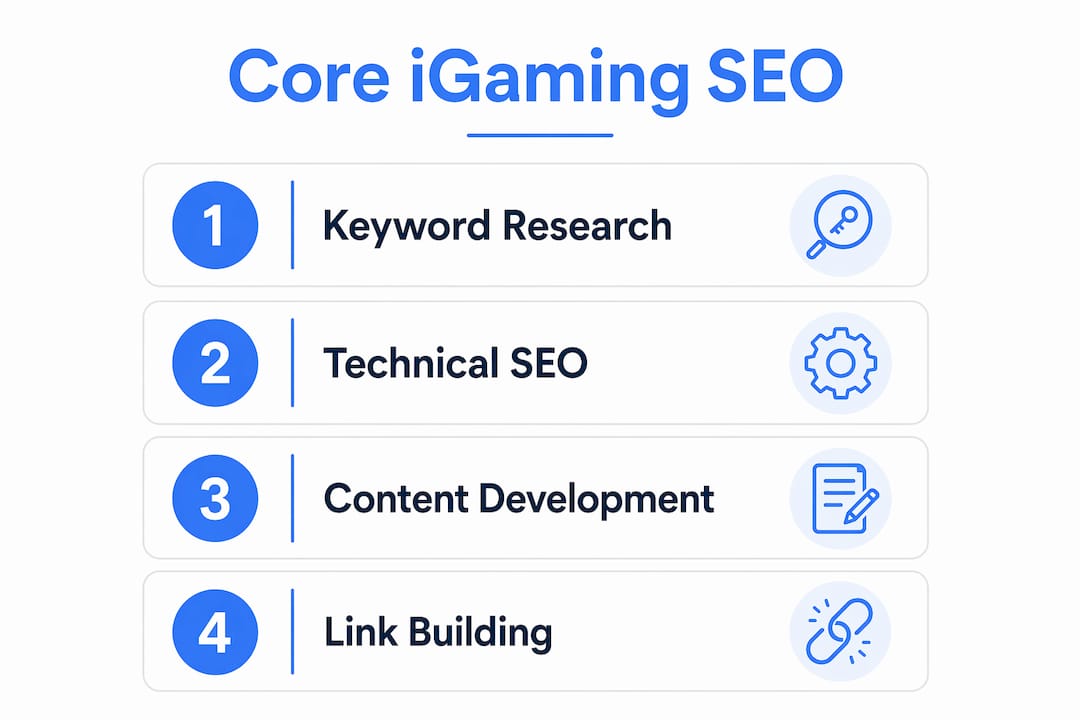
iGaming SEO is composed of four core disciplines: keyword research, technical SEO, content development, and link building. Each one requires adaptation for the regulated gambling environment. Generic SEO tactics applied without modification produce weak results in this market.
Keyword research in iGaming must account for jurisdictional variation. A term like "online casino" carries different legal weight and search volume in the United Kingdom versus Canada versus Germany. Effective online gaming SEO maps high-intent queries by market, then filters for regulatory compliance before any content is written.

Technical SEO addresses crawlability, indexation, JavaScript rendering, and Core Web Vitals. iGaming platforms are frequently built on JavaScript-heavy frameworks, which creates indexation gaps that kill organic visibility before a single piece of content goes live.
Content development must satisfy both user intent and regulatory standards. A bonus page for a UK-facing operator must comply with Advertising Standards Authority (ASA) guidelines while still ranking for competitive terms. That dual constraint separates iGaming content from general web copy.
Link building operates in a restricted ecosystem. Many publishers refuse gambling content outright, and those who accept it command premium placement. Quality and topical relevance matter far more than volume in this environment.
iGaming SEO agencies typically begin with a full audit covering all four areas, then produce a prioritized roadmap with a keyword strategy, content calendar, and link acquisition plan specific to gambling verticals.
- Keyword strategy segmented by jurisdiction and regulatory status
- Technical audit covering crawlability, indexation, and Core Web Vitals
- Content calendar aligned with compliance requirements and search intent
- Link acquisition plan targeting gambling-friendly publishers
- Performance framework tied to FTDs and registrations, not just rankings
Pro Tip: Map your keyword targets against the specific gambling regulations of each jurisdiction before writing a single page. A term that ranks well in one market may be restricted or prohibited in another, and publishing non-compliant content creates legal exposure alongside SEO risk.
How do technical SEO challenges affect iGaming websites?
JavaScript rendering is the single largest technical risk for iGaming platforms. Google uses a two-phase indexing process: it first crawls raw HTML, then renders JavaScript in a separate queue that can lag by days or weeks. Sites with large JavaScript-rendered page sets often see only partial indexing. For a casino platform with thousands of game pages, partial indexing means thousands of pages generating zero organic traffic.
Server-side rendering (SSR) and prerendering solve this problem directly. SSR delivers fully rendered HTML to Googlebot on the first request, eliminating the rendering queue entirely. Prerendering generates static HTML snapshots for crawlers while keeping the dynamic experience for users. Both approaches require developer resources, but the indexation gains justify the investment.
Verifying what Googlebot actually indexes using Google Search Console's URL Inspection tool is more reliable than assuming content renders correctly. Operators should audit a representative sample of pages monthly, not just at launch.
Multi-jurisdiction deployments add another layer of complexity. Multi-language and jurisdiction setups require verified hreflang implementation, correct handling of location-based content logic, and crawlability checks across every market variant. A misconfigured hreflang tag can send UK traffic to a German-language page, destroying both user experience and rankings.
| Technical challenge | Root cause | Solution |
|---|---|---|
| Partial indexation | JavaScript rendering delays | Server-side rendering or prerendering |
| Hreflang errors | Incorrect multi-market configuration | Specialized multi-jurisdiction audit |
| Core Web Vitals failures | Heavy scripts and unoptimized assets | Performance budgets and lazy loading |
| Location-based content gaps | Dynamic geo-targeting logic | Crawl verification per market variant |
Pro Tip: Run URL Inspection on your highest-value pages every time a major JavaScript framework update ships. Framework updates frequently break rendering behavior in ways that standard monitoring tools miss until rankings drop.
Compliance-aware targeting and Core Web Vitals optimization are standard requirements for any iGaming site competing in regulated markets. Mobile-first indexing amplifies these requirements because Google evaluates mobile performance as the primary signal for all rankings.
What role does content strategy and link building play in iGaming SEO success?
Content is the primary mechanism for building topical authority in a market where affiliates dominate the first page of results. Affiliates publish at high volume and maintain aged domains with strong backlink profiles. Operators competing against them need content that demonstrates genuine expertise, not just keyword density.
The E-E-A-T framework (Experience, Expertise, Authoritativeness, Trustworthiness) defines how Google evaluates content quality for gambling pages, which fall into the Your Money or Your Life (YMYL) category. Raters assess whether content reflects real experience, aligns with user intent, and carries credible trust signals. Author credentials, transparent ownership disclosures, and accurate regulatory information all contribute to E-E-A-T scores.
AI search tools now directly influence how operators acquire players. AI tools like ChatGPT, Perplexity, and Gemini handle high-intent queries at the decision stage of the gambling funnel. Brands not cited by these models lose visibility at the exact moment a player is choosing where to deposit. Structuring content with direct answers, explicit schema markup, and entity linking increases the probability of AI citation.
"Brands not cited by AI models risk invisibility at moments of decision. AI search optimization demands explicit schema markup for entities, dated content, and direct structured answers to improve the likelihood of citation by large language models."
Effective content programs for iGaming publish on a consistent schedule. Topical authority builds through coverage depth, not single articles. A site that publishes one comprehensive guide per week across a defined topic cluster outperforms a site that publishes sporadically across unrelated subjects.
Link building in iGaming requires relationship-based outreach rather than mass prospecting. Relationships with gambling-friendly publishers are key differentiators because most link sellers distrust gambling clients and most quality publishers have blanket exclusions for the vertical. Operators who invest in genuine editorial relationships with relevant publishers build link profiles that resist algorithmic penalties.
- Publish content on a fixed weekly schedule to build topical authority consistently
- Use schema markup (FAQPage, Article, Organization) on every page targeting AI citation
- Include author bios with verifiable credentials on all YMYL-adjacent content
- Prioritize legal and compliance accuracy in every piece of regulated market content
- Build publisher relationships before you need links, not after a penalty
How is performance measurement managed in iGaming SEO?
SEO measurement in iGaming fails when operators track rankings and traffic without connecting them to revenue events. Measuring SEO success must align KPIs with gambling funnel events such as sign-ups and first deposits. Rankings and organic sessions are leading indicators. FTDs and registrations are the actual business outcomes.
A practical measurement framework for iGaming SEO covers four levels:
- Ranking visibility: Track target keywords by jurisdiction weekly. Segment by market because a position-three ranking in the UK and a position-three ranking in Canada represent different traffic volumes and conversion rates.
- Organic traffic quality: Monitor sessions, bounce rate, and pages per session from organic search. Traffic that does not engage does not convert.
- Funnel conversion events: Connect Google Analytics 4 (GA4) with your CRM to track registrations and FTDs attributed to organic search. This requires proper UTM configuration and event tracking from day one.
- Revenue attribution: Calculate organic search contribution to gross gaming revenue (GGR) monthly. This number justifies SEO investment to stakeholders and identifies which content clusters drive the most value.
Tracking rankings, traffic, and FTDs from day one is the standard for tying SEO performance to business growth. Without this attribution, operators cannot distinguish between SEO-driven growth and growth from paid channels or direct traffic. Multi-channel complexity makes clean attribution difficult, but integrating GA4 with CRM data produces a reliable enough signal for decision-making.
AI and cloud services now support more granular attribution modeling, allowing operators to assign partial credit across touchpoints rather than relying on last-click models that systematically undervalue SEO.
Key Takeaways
Effective iGaming SEO requires compliance-aware technical execution, E-E-A-T content strategy, relationship-based link building, and funnel-level measurement tied directly to player acquisition outcomes.
| Point | Details |
|---|---|
| Start with a full audit | Map technical gaps, content weaknesses, and link profile before building any strategy. |
| Fix JavaScript indexation first | Use SSR or prerendering to close indexation gaps before publishing new content. |
| Align content with E-E-A-T | Include author credentials, compliance accuracy, and schema markup on all YMYL pages. |
| Build publisher relationships early | Gambling-friendly link placements require trust built over time, not mass outreach. |
| Measure FTDs, not just rankings | Connect GA4 to your CRM from day one to track SEO's direct contribution to revenue. |
Why iGaming SEO in 2026 demands a different mindset
I have watched operators spend significant budgets on SEO programs that produced strong rankings and weak revenue. The pattern is consistent: the team optimized for the metrics they could see (positions, sessions) and ignored the metrics that mattered (registrations, FTDs). That disconnect is the most common and most expensive mistake in iGaming digital marketing.
The AI search shift makes this worse if you are not prepared. ChatGPT and Perplexity now answer decision-stage queries directly. If your brand is not structured for citation, you are invisible at the moment a player decides where to deposit. Schema markup and direct-answer content are not optional extras in 2026. They are baseline requirements.
Technical debt is the other silent killer. I have audited platforms where JavaScript rendering issues had been present for over a year without anyone noticing because rankings had not collapsed yet. They were just growing far slower than they should have. Fixing rendering issues on a large iGaming platform typically produces ranking gains within two to three months, with no new content required.
The operators who win in this market treat SEO as a revenue function, not a marketing function. They measure it against FTDs, hold it accountable to the same standards as paid acquisition, and invest in the technical and editorial infrastructure that makes compounding growth possible. That discipline is the actual differentiator, not any single tactic.
— Mihail
How Igamingecosystem connects you to the right iGaming partners
Executing a strong SEO program requires more than tactics. It requires the right technology partners, platform infrastructure, and traffic management tools working together.
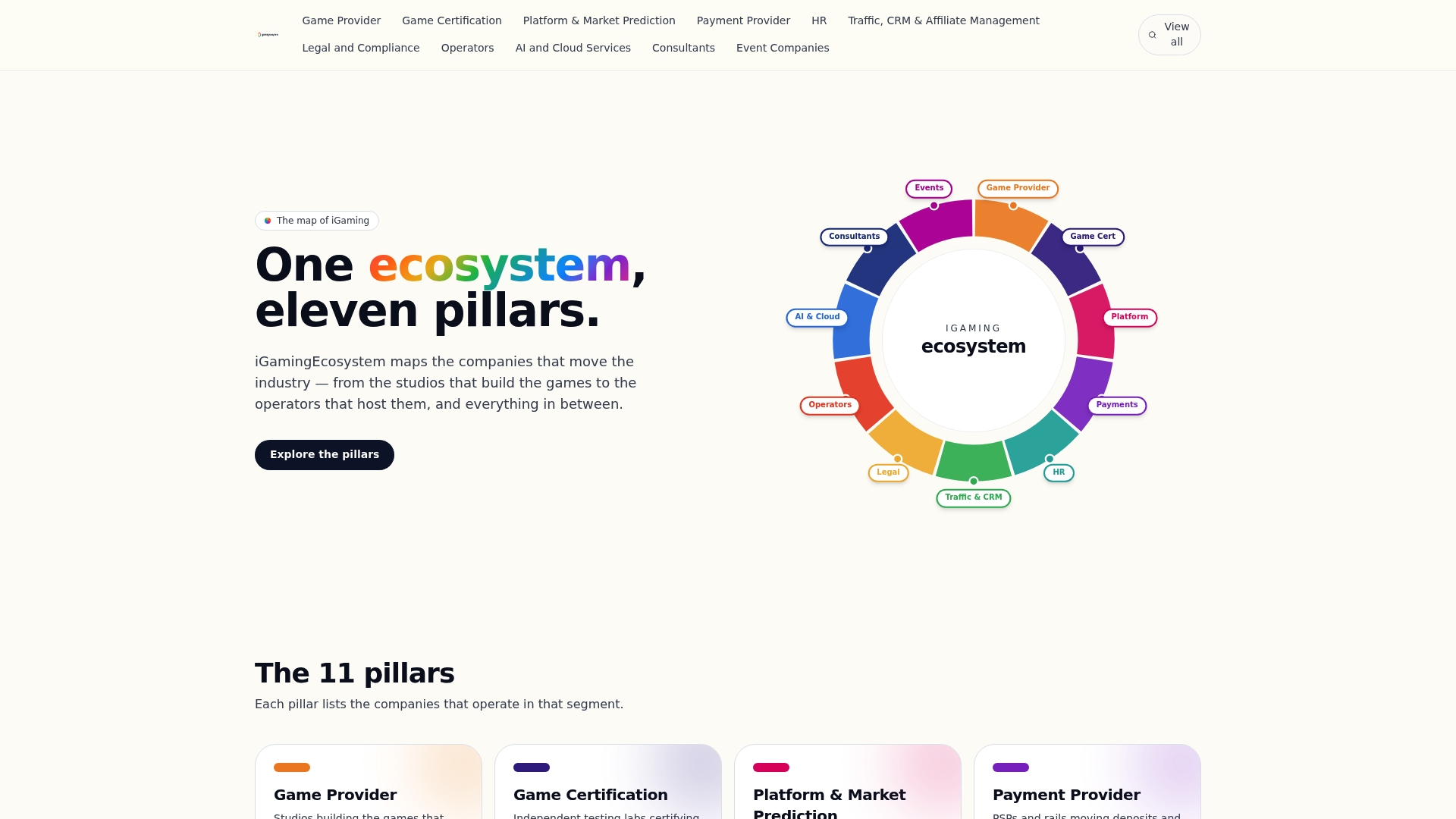
Igamingecosystem maps the full iGaming supply chain across eleven industry pillars, from game providers and platform solutions to traffic and affiliate management services that integrate directly with organic search strategies. Operators building or scaling their SEO programs can use Igamingecosystem to identify certified vendors, compliance partners, and platform providers suited to their specific market. The directory connects you to verified industry participants rather than generic listings, saving the time that would otherwise go into vetting providers from scratch.
FAQ
What makes iGaming SEO different from standard SEO?
iGaming SEO operates under regulatory compliance constraints, a restricted link ecosystem dominated by affiliates, and success metrics tied to player deposits rather than traffic volume. These factors require specialized tactics that standard SEO programs do not address.
How long does it take to see results from casino SEO services?
Technical fixes like JavaScript rendering corrections typically produce ranking improvements within two to three months. Content and link building programs generally require six to twelve months to generate measurable organic traffic growth in competitive gambling markets.
What is E-E-A-T and why does it matter for gambling sites?
E-E-A-T stands for Experience, Expertise, Authoritativeness, and Trustworthiness. Google applies this framework rigorously to gambling content because it falls under the YMYL category, meaning low-quality or inaccurate content carries real-world risk for users.
How should iGaming operators structure content for AI search citation?
AI search tools prioritize content with direct answers, explicit schema markup, and clear entity linking. Publishing dated, structured content with FAQPage and Article schema increases the probability that models like ChatGPT and Perplexity cite your brand in decision-stage queries.
Which KPIs should iGaming SEO programs track?
The primary KPIs are keyword rankings by jurisdiction, organic sessions, registration rate from organic traffic, and FTDs attributed to organic search. Connecting GA4 to your CRM from the start of the program is the only reliable way to track the full funnel.