
iGaming affiliate networks are defined as intermediary platforms that connect performance marketers with gambling operators, paying commissions for every qualified player delivered. The three standard commission models are CPA (cost per acquisition), RevShare (revenue share), and Hybrid arrangements that combine both. CPA rates can reach €700+ per depositing player, while RevShare programs typically range from 30% to 80% of net gaming revenue. These ranges reflect the high lifetime value operators place on quality players, which is why the iGaming affiliate market remains one of the most competitive in performance marketing.
1. What commission models and payment terms should you expect?
The three commission models each serve a different risk profile. CPA pays a fixed amount per first-time depositor (FTD), giving you immediate, predictable income. RevShare pays a percentage of the player's net losses over their lifetime, which compounds over time but requires patience. Hybrid combines an upfront CPA with a lower ongoing RevShare, balancing short-term cash flow with long-term upside.
RevShare ranges from 30% to 80% depending on traffic volume and negotiated terms. That spread is significant. A marketer sending 500 FTDs per month earns far more at 50% RevShare than at 30%, so negotiating your rate from day one matters.

Minimum payout thresholds vary widely across gaming affiliate networks. Common thresholds are $20, $50, $100, and €200, with payment frequency options ranging from weekly to monthly. Networks offering weekly payouts are preferable for marketers managing active ad spend, since faster cash flow reduces financial exposure.
| Commission Model | Typical Rate | Minimum Payout | Payout Frequency |
|---|---|---|---|
| CPA | Up to €700+ per FTD | $50–$100 | Weekly or bi-weekly |
| RevShare | 30%–80% of net revenue | $20–$200 | Monthly |
| Hybrid | Fixed CPA + reduced RevShare | $50–$100 | Weekly or monthly |
Pro Tip: Negotiate your RevShare rate before you send your first click. Networks rarely volunteer their top tier. If you have traffic data from a previous campaign, use it as proof of quality to justify a higher starting rate.
2. Which features do top gaming affiliate networks provide?
The best networks offer more than a commission structure. They provide the infrastructure that determines whether your campaigns scale or stall.
Key platform features to evaluate include:
- Multi-brand catalogs: Networks covering 50+ countries give you access to multiple operator brands under one contract, reducing the administrative load of managing separate agreements.
- GEO coverage: Broad geographic reach lets you test traffic from Tier 1, Tier 2, and emerging markets without switching networks.
- Tracking integration: Registration, traffic vetting, and technical setup via postback or API typically takes a few days. Postback is the standard for server-side tracking; API integration suits more advanced setups.
- Affiliate manager support: A dedicated manager who responds within 24 hours is a functional advantage, not a luxury. They approve creatives, unlock GEOs, and escalate payment issues.
- SmartLink solutions: These automatically route traffic to the highest-converting offer based on GEO, device, and traffic source, useful for affiliates with mixed or untargeted traffic.
- Marketing materials: Quality networks supply localized banners, landing pages, and pre-landers. Weak creative libraries force you to build everything yourself.
Pro Tip: External tracking platforms like CPV Lab give you placement-level and creative-level data that network dashboards never show. That granularity is what separates profitable campaigns from break-even ones.
3. How to select the best iGaming affiliate network for your goals
Choosing the right network starts with matching its strengths to your traffic profile. A network with deep coverage in Germany is the wrong choice if your audience is primarily from Brazil.
The affiliate manager relationship often determines whether you access preferential commission tiers and exclusive GEO offers. This is not a soft benefit. Affiliates with strong manager relationships consistently receive higher caps, faster approvals, and advance notice of new offers before they go public.
Use this framework when evaluating any network:
- Commission rate vs. conversion quality. A high CPA is worthless if the operator's landing page converts at 0.5%. Request historical EPC (earnings per click) data before committing.
- Traffic source compatibility. Confirm the network accepts your traffic type: SEO, paid social, email, or native. Some networks ban certain sources outright.
- GEO specialization. Match the network's strongest markets to your audience geography. Misaligned GEOs produce low approval rates.
- Payment reliability. Check community forums and affiliate groups for payment delay reports. Late payments are a consistent red flag.
- No-negative-carryover policy. No-negative-carryover policies protect your RevShare income when a player has a winning month. Without this protection, a single big winner can wipe out your earnings for that period.
- Tracking transparency. Networks that share detailed reporting give you the data needed to optimize. Opaque dashboards hide problems until they become losses.
Pro Tip: Run a small test budget with any new network before committing your primary traffic. Two to four weeks of data tells you more than any sales call.
4. How to build a network portfolio that protects your revenue
Professional affiliates maintain multiple networks simultaneously, using one as their primary revenue source and others for testing. This is not redundancy. It is risk management.
A single network relationship creates a single point of failure. Operators change terms, suspend offers, or exit markets without warning. Affiliates who depend on one source lose income overnight. A portfolio approach means a disruption in one network does not stop your business.
The table below maps network types to affiliate profiles and use cases.
| Affiliate Profile | Primary Network Type | Secondary Network Role |
|---|---|---|
| Beginner (under 100 FTDs/month) | Broad multi-brand network | Test one niche or GEO-specific network |
| Intermediate (100–500 FTDs/month) | Specialized GEO network | Rotate offers across two to three networks |
| Experienced (500+ FTDs/month) | Direct operator deal or top-tier network | Use secondary networks for overflow and testing |
| SEO-focused affiliate | Content-friendly network with long RevShare | Add CPA network for quick monetization |
| Paid media affiliate | CPA-heavy network with fast payouts | Add RevShare network for long-term income |
Sustainable conversion quality matters more than headline CPA rates. Networks monitor traffic quality closely. Accounts sending low-quality or incentivized traffic face commission reductions or bans. Protecting your account standing is as important as finding the right offer.
FTD requirements and transparent quality control are features of networks that operators trust. When an operator trusts the network, they invest in better offers and higher caps, which benefits every affiliate on the platform.
Key takeaways
The most effective approach to iGaming affiliate networks combines competitive commission negotiation, external tracking, and a diversified network portfolio to protect and grow revenue.
| Point | Details |
|---|---|
| Commission model selection | Match CPA, RevShare, or Hybrid to your cash flow needs and traffic volume. |
| Affiliate manager relationship | Build direct contact early; it unlocks better rates and exclusive GEO access. |
| External tracking is non-negotiable | Use platforms like CPV Lab for placement-level data beyond network dashboards. |
| Portfolio diversification | Maintain a primary network and at least one secondary to reduce revenue risk. |
| Traffic quality over volume | Networks monitor FTD quality; low-quality traffic leads to account restrictions. |
What I've learned after years of watching affiliates succeed and fail
The affiliates who build lasting income from iGaming are not the ones chasing the highest CPA on any given week. They are the ones who treat their affiliate manager like a business partner, not a support ticket. That relationship is where the real advantages live: early access to new GEOs, custom commission structures, and advance warning when an offer is about to change.
The second pattern I see consistently is the gap between what affiliates think they know about their traffic and what the data actually shows. Network dashboards show you conversions. They do not show you which placement, which creative, or which audience segment drove those conversions. Without that detail, you are optimizing blind. External tracking is not optional for anyone serious about this business.
The third thing I would tell any marketer entering this space: do not let a strong month on one network convince you that you do not need a backup. The iGaming affiliate market moves fast. Regulatory changes, operator exits, and offer suspensions happen without notice. The affiliates I have seen recover quickly are always the ones who had a second network already producing results, even at a smaller scale.
The affiliate management infrastructure you build around your campaigns matters as much as the offers you promote. Treat it as a core part of your operation, not an afterthought.
— Mihail
Igamingecosystem maps the iGaming affiliate ecosystem for you
Igamingecosystem is a structured directory of the iGaming industry, covering eleven operational pillars from game certification to payment infrastructure. For affiliate marketers, the most relevant sections are affiliate traffic management, which covers CRM and tracking integration, and the payment provider directory, which identifies the infrastructure behind reliable affiliate payouts.
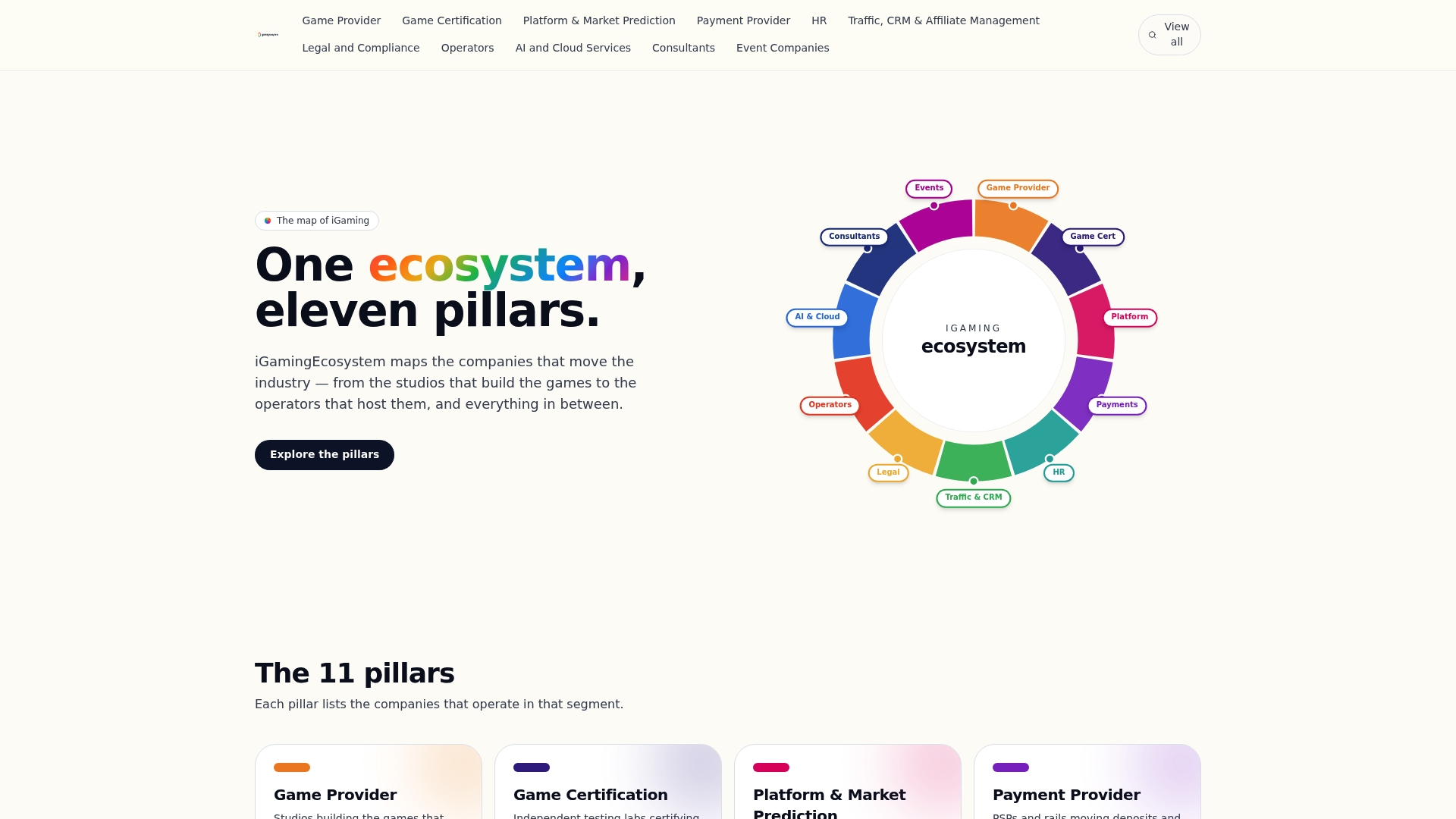
Igamingecosystem also catalogs game providers and operators, giving affiliates a clear picture of who is behind the products they promote. When you understand the full supply chain from developer to operator to affiliate network, you make better decisions about which partnerships to prioritize. Igamingecosystem gives you that view in one place.
FAQ
What are iGaming affiliate networks?
iGaming affiliate networks are platforms that connect performance marketers with gambling operators, paying commissions for referred players under CPA, RevShare, or Hybrid models.
How much can you earn from iGaming affiliate programs?
CPA rates can reach €700+ per first-time depositor, while RevShare programs pay 30%–80% of net gaming revenue over the player's lifetime.
What is the difference between CPA and RevShare in iGaming?
CPA pays a fixed amount per qualifying deposit; RevShare pays a recurring percentage of the player's net losses, which compounds over time but requires a longer payback period.
How do you choose the best iGaming affiliate network?
Match the network's GEO strengths to your traffic source, confirm it accepts your traffic type, verify payment reliability, and check whether it offers a no-negative-carryover policy on RevShare.
Why do professional affiliates use multiple networks?
Diversifying across networks reduces the risk of revenue loss from offer suspensions, operator exits, or regulatory changes that affect a single network.